

Full Verse Review: Magical Girl Masquerade by KaliopeD

I struggled with the approach I should take with this review.
Usually, when I review a piece of web fiction, I have two goals. The first is to give readers an informed idea of what to expect should they choose to explore the title.
The second is to provide actionable feedback to the authors who trust me with their stories.
And if that feedback happens to be interwoven with petty megalomania, cosmic weirdness, or a reminder that we must never underestimate the coming dominion of our future orca overlords, all the better.

Magical Girl Masquerade poses no challenge to the first goal.
You can expect polished prose, vivid description, and voice-driven narration that tilts the lens just enough to colour every event with its villain-protagonist’s melodramatic flair.
You can expect wicked wizardry, Machiavellian machinations, and dastardly deeds done in the dark.
Not for nothing, but if we went on a date, you could expect much the same.

You can expect to have fun with this novella. I certainly did. The premise is inventive. Its execution?
Indulgent in the very best of ways.
However, it is the second goal of my reviews that presents the difficulty.
For this story was drafted using AI.
And what possible advice could I render to a machine?
Well, that is not entirely fair.
The author openly acknowledges using AI to produce the initial drafts. From there, they meticulously edited the machine’s output for coherence, continuity, clarity and chastity.

All right, perhaps not the last one, but my collection of appropriate words beginning with “C” was looking rather thin.
According to the author, the premise was theirs. The story and its major beats were theirs. The characters and their personalities were of the author’s original design.
They supplied the machine with the details of their plan, took its output and extensively reshaped it. The creative direction was theirs. The selection was theirs. The final editorial decisions were theirs.
The initial prose was not.
The final product…
That is a little greyer.
In my previous editorial, I explored what I consider reasonable uses of AI—and what I consider the dark wizardry of allowing the machine to seize the pen.
I must be honest: this story sits firmly beyond the boundary of what I would consider reasonable use.
But I enjoyed it.
And I read the whole thing.
Where it lacked a certain depth of internality, I found that very absence suited its gloriously shallow villain-protagonist. It fit him so well, in fact, that it became difficult to distinguish a limitation of the drafting process from a deliberate stylistic choice.
Ultimately, I chose to review this story.
So review it, I shall.
From this point onward, I will focus primarily on the experience I had as a reader, setting aside the circumstances of the story’s composition except where they materially affect the finished work.
There remains, after all, a human author behind its premise, direction and final form.
Characters & Voice
Magical Girl Masquerade follows the zany antics of an everyday megalomaniacal dark magician who goes by the entirely standard Christian name of Shadow Weaver.

He’s a performer. An actor. A lover of the stage.
Where lesser actors merely play the parts they are given, Shadow Weaver fully inhabits the roles he takes…
By force.
Illusions.
Shapeshifting.
And a teeny-tiny little bit of physical and psychological torture.
He’s a ba*tard with all the conscience and compunction of a superintelligent rattlesnake.
I take that back. At least the snake’s rattle gives you some warning of what it is. Shadow Weaver disguises his nature behind counterfeit empathy and charm.
He is a master of rituals, dark magic and beguilement. He uses these gifts to direct the world around him into his own private performance.
Take this excerpt, for example:
“The transformation complete, the disguised Shadow Weaver stepped out from behind the tree. Ah, the familiar thrill: stepping into a role, feeling it settle across his shoulders like a cloak. […] Heroes might think they fought monsters; he gave them theatre.”
I described this novella as melodramatic. I meant that in the more technical sense: heightened conflict, moral polarisation and characters drawn without much ethical ambiguity.
Think Golden Age Superman as one example.
As for the other, you can think of my ex.

Shadow Weaver is pure evil—and he is perfectly happy with that.
If you enter the story expecting moral quandaries or a character wrestling with the consequences of the wrongs he has wrought, those expectations will be swiftly denied.
He has an evil mind. He schemes evil schemes. He delights in every deception, and when his machinations succeed, he feels nothing but joy.
The novella is written exclusively from his perspective. Consequently, every hurt he inflicts is rendered as part of a game. The genuine emotions of the people he manipulates are flattened into moves. It is as though he is playing against himself, with every other character reduced to a piece he shifts around the board.
As a result, Shadow Weaver always feels dynamic.
Never passive.
He feels like the only real person in every scene.
It also means that you never quite connect with his victims. I did not, at least.
That is not to say that they do not express true-to-life emotions or believable vulnerabilities. Rather, the story presents those vulnerabilities primarily as weak points for Shadow Weaver to exploit.
Take this excerpt, for example:
“Everything’s falling apart,” Sophia’s voice hissed from inside the room. “First Diana’s betrayal, now Lily’s talking about taking a break from patrol duties!” […] Shadow Weaver allowed a small, mischievous smile to ghost across his lips before rehearsing Emily’s tearful tableau: red-rimmed eyes, running makeup, trembling fingers—the perfect image of fragility, if one ignored the mind directing every tremble.”
He is the only character of consequence.
There is a certain dark glee to be found in following his perspective. What readers should not expect is to become deeply invested in anyone else.
To wit, it feels almost futile to discuss the rest of the cast.
Suffice it to say, they are five magical girls.
Think Sailor Moon.
Cardcaptor Sakura.
Minky Momo.
Or a certain Bard-in-Chief when he is certain no one is watching.

These girls embody a range of tropes common to the genre: the hope-filled leader, the fiery reformed rebel and the girl secretly afraid to face the world alone.
Ultimately, however, they amount to different tensions for Shadow Weaver to set against one another.
It is difficult to determine whether this flattening of the supporting cast was intentional, or whether it reflects AI’s limited ability to balance multiple characters’ motivations, intentions and importance across a long-form narrative.
The author insists that every story decision was theirs. Had this novella been an entirely human effort, I would have had no difficulty interpreting its narrow perspective as a deliberate choice—one intended to let readers revel in Shadow Weaver’s wickedness without baulking too hard at what he actually does.
Ultimately, however, the only question that matters for this review is whether it works.
Across a longer story, perhaps it would not.
For the story the author has written, I found that it did.
What troubled me more was that I constantly found myself wondering why Shadow Weaver did any of it.
Beyond ‘for the lulz’, I never quite found an answer.
Narrative & Structure
Much like the line separating a lunch date with me from a certain Stephen King story, the pacing of this novella is tight.
It has to be.

Clocking in at just one hundred and eighty-nine pages across thirty-two chapters, the novella does not have much room to waste.
Perhaps fast is not quite the right word to describe it.
It does not detour.
Its attention remains fixed on Shadow Weaver’s campaign to investigate, corrupt and control the five magical girls. There is little room for side adventures, competing plotlines or divided interests.
Despite that focus, individual scenes are not hurried from one event to the next. The author lingers over Shadow Weaver’s deceptions. The emotional manipulations disguised as conversations are not skipped or summarised.
The dark glee Shadow Weaver takes in impersonating his victims is vividly expressed, as is his contempt for anyone who attempts to play his games.
The prose is reflective, lingering on Shadow Weaver’s perception of his own performance and the reactions it draws from the rest of the cast.
Early in the story, trouble is predicted at an upcoming masquerade ball. From that point onwards, the narrative remains fixed upon that destination.
From the beginning, it keeps its eyes on the end.
And it delivers…
Perhaps a little too closely to expectations.
Worldbuilding & Themes
The worldbuilding in Magical Girl Masquerade is deliberately sparse.
Beyond the inclusion of magic, demons, spells and charms, its scarcely explored world appears very similar to our own.
The action takes place on the campus of Grand Pacific University, and besides the witchcraft and sorcery, there is little to distinguish the setting from an ordinary modern university.
Keeping the world contained is a clever choice. As I mentioned above, the narrative is tightly focused; veering off into the stranger details of the wider world would have diluted that focus.
Instead, the author gives us a setting that requires little effort to envisage, allowing Shadow Weaver and his machinations to remain the story’s principal draw.
The magical elements are similarly woven into the world without explanation. Magic is simply a quirk of its existence—no different from storms, crime, or some bard’s inclination to bay wildly at the moon in the hope that she returns his calls.

Magic is treated as commonplace. The story does not pause to explain its origins or underlying cause. It demonstrates magic, implies its history, allows the surrounding characters to react to it, and then moves on. The reader is invited to accept its existence without thinking much further about it.
As for the themes, this story is not an exploration of good versus evil—or of how power corrupts.
Perhaps it could have been, but Shadow Weaver was evil from the beginning, and the narrative never pauses to offer much explanation as to why.
Perhaps it is an exploration of how our insecurities can be twisted against us when we leave them unguarded.
Perhaps not.
Being honest with you—a state I would rather avoid, but cannot help for the moment—I doubt the author set out to incorporate particularly deep themes into the narrative.
The story is meant to be stylish.
It is meant to be delightfully cruel.
It is not a treatise on anything beyond pure enjoyment—or, on a more meta level, an example of what AI authorship can produce beneath a firm human hand.
As entertainment, Magical Girl Masquerade is a success.
Those seeking deep, thought-provoking prose, in which every character matters and readers are encouraged to engage their minds and consciences, will find little of that here.
If that had been the author’s target, I would be considerably more critical.
I do not believe it was.
For what this story is, I would call it fit for purpose.
Craft
I will not say much in this segment for one simple reason: the initial drafting was achieved through A.I.
Whatever perspective you might have on A.I., the machine can write, and it can write really well.
The prose is clean. I did not notice any grammatical errors or anything of the sort.
If I were to render any criticism, it would be that the writing felt very conventional. The figurative language was effective, if generic, and I rarely noticed the kind of flair that emerges from the creative chaos of a human-written effort.
That strange collision of memory, obsession and private derangement that causes one author to compare the dawn to opening fingers, and another to compare it to a former lover crawling through the bedroom window with a restraining order folded between her teeth.

Take this segment as an example:
“Shadow Weaver arrived at The Mystical Bean cafe as dawn stretched its sleepy fingers across New Pacifica City. Selene’s form—ah, delightful Selene—clung to him like a properly fleshed out supporting character. […] Shadow Weaver descended into the basement, the cool darkness greeting him like an old ally. The box on the desk drew his attention immediately. The focus stones lay within, their polished surfaces marred by tiny flecks of black, as though their corruption had already begun. […] Five stones. Five threads. One perfect pentacle.”
Evocative?
Absolutely.
Daring and particular?
I do not think so.
‘Dawn stretched its sleepy fingers’ is effective. It creates an immediate image. It also feels like a metaphor I have encountered wearing several different hats and false moustaches across a dozen other stories.
The same is true of darkness greeting someone ‘like an old ally’, or corruption appearing as flecks of black. None of it is bad. All of it works. But it is familiar work, carried out efficiently by phrases that have been used before.
But here is the thing: I have read countless strictly human-authored stories that do not approach the kind of polish Magical Girl Masquerade employs.
Some are all but entirely devoid of figurative language. Others are far more generic than the example offered above. Being produced by a human does not automatically make prose vivid, inventive or good. Sometimes the sacred flame of human creativity produces a candle. Sometimes it produces smoke. Sometimes it burns the curtains and leaves the author insisting the damage is symbolic.

Attempting to separate my genuine criticism of the prose from my bias in knowing how it came about is challenging.
Being honest again—I do not like it either—I doubt this would have registered as a point of particular criticism if I had gone in unaware that I was reading A.I.-generated content.
For this story, it works well enough. More than well enough, in places.
For the craft of writing as a whole…
I worry that A.I. could bring about a world described with increasing polish through an ever-shrinking range of language.
Closing Thoughts
Magical Girl Masquerade presents me with an uncomfortable conclusion.
I do not approve of the machine seizing the pen. Nevertheless, under the firm direction of a human hand, it has produced something polished, focused and thoroughly entertaining.
Shadow Weaver is a delightfully cruel protagonist who dominates both the narrative and everyone unfortunate enough to wander into it. The magical girls possess rather less substance, but they fulfil their purpose as victims, obstacles and catastrophically poor judges of character—much like everyone who has ever agreed to date me.
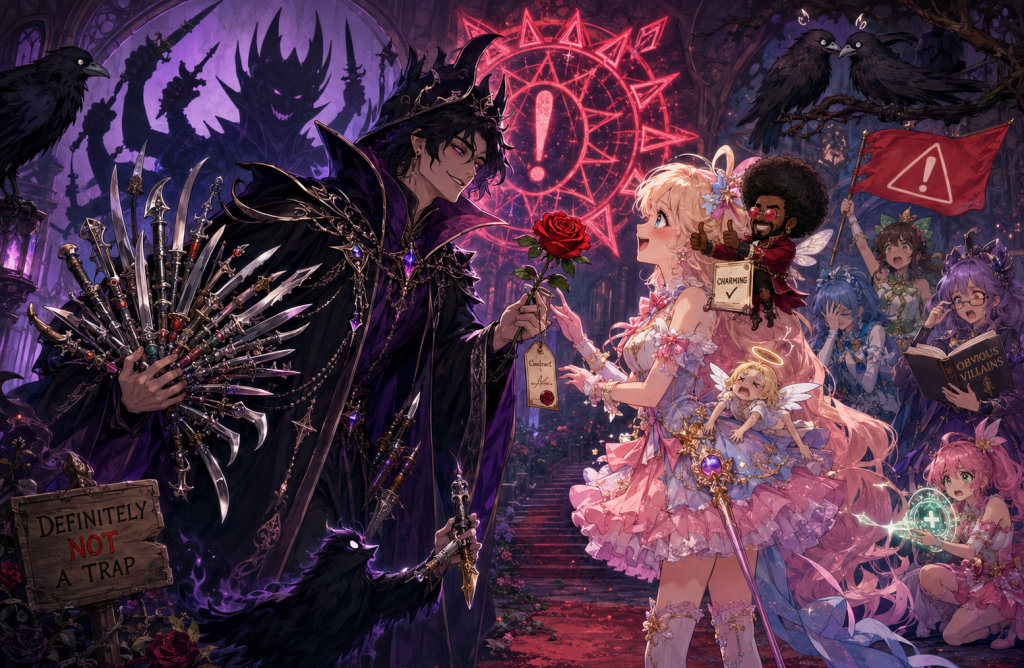
The world is scarcely explored, the themes are not especially deep, and the prose—though clean and effective—rarely escapes the familiar. This is not a story that demands contemplation. It demands popcorn and a willingness to watch a superintelligent rattlesnake dismantle several lives with theatrical enthusiasm.
If judged as profound, thought-provoking fiction, it falls short. I do not believe that was ever its ambition.
Judged as stylish, tightly focused villainous entertainment, however, Magical Girl Masquerade succeeds. Against my principles, better judgement and rapidly deteriorating romantic prospects, I enjoyed it.
| Scorecard (★★★★★) | |
| Category | Rating |
| Character & Voice | ★★★☆ |
| Narrative & Structure | ★★★★☆ |
| World Building & Themes | ★★★ |
| Craft | ★★★★☆ |
| Overall | ★★★★ |
Clone_v2 is the Bard-in-Chief of Bardic Planet.
When he’s not condemning Shadow Weaver’s methods while quietly wondering whether they might improve his own romantic prospects, he’s writing original web fiction on Royal Road.
Check out: Captured Sky—a brutal, high-stakes fantasy set in the unforgiving world of the Dungeon.
New chapters drop twice a week.
Author

Discover more from Bardic Planet
Subscribe to get the latest posts sent to your email.


