

EXTENDED CUT! First Impressions: Binary Systems by minichirops
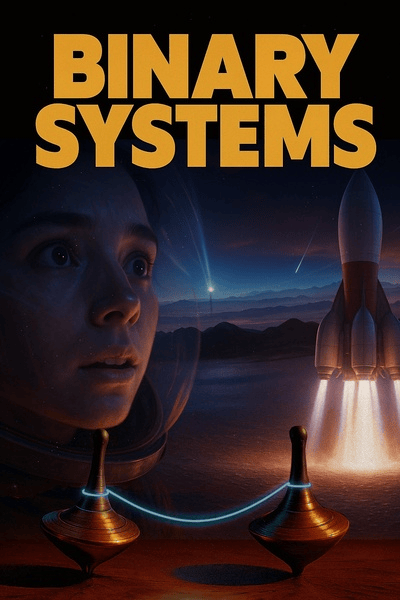
‘A love story stretched across millions of miles, held together by a virtual world, and somehow made to feel painfully real.’
Core Premise & Initial Impressions
Love is a powerful force.
It moves us. For some, it moves us to act upon our romantic passions towards the object of our amour: gifting them flowers, jewellery, and words of poetic lyricism drawn from the heart…
Ed Sheeran’s heart, to be precise. But as long as it is not the thought that counts, a few lovely ladies are sure to be wooed.
For others, such as Gordon Stone—the male protagonist of Binary Systems—love may yet move him from the world entirely.
Star-crossed, this Romeo may be, but ‘thus with a kiss’ is simply not in the cards.
Marie—Gordon’s one and only, and the female protagonist of the story—lives on Mars. That is not to say she has a lovely personality, or that she is bubbly but should lay off the snacks.
When I say Mars, I do not mean the chocolate. I mean the planet.
Ladies and gentlemen, you have it right. Marie is a Martian.
Born on Mars, she lives on Mars, and is slated to die on Mars sooner than she would on Earth.
Her living space is confined. Her view is restricted. The blessed breath of a brisk breeze we take for granted on Earth is sadly foreign to Marie.
So what does that mean for Gordon?
A more cynical man than your Bard-In-Chief would say he should run for the hills he can actually breathe on, and find a gal who shares, if not the same time zone, at least the same planet.
Your Bard-In-Chief might not be six-foot-six stood on the ground weighing two-hundred-and-thirty-five pounds. Even still, he believes in a thing called love.
Not for nothing, he apparently also believes in referring to himself in the third-person.
Gordon believes the same. Not the whole third-person thing—admittedly, that would be odd.
What he shares with your Bard-In-Chief is a belief in love so powerful he would surrender everything to it.
I can sympathise. I truly can.
I once surrendered restraint for love, declaring my devotion for all to hear from atop a cherry-picker I rented and stationed outside my heart’s affection’s abode.
I surrendered dignity for love, as passers-by laughed and jeered at my rendition of Don’t You Want Me by The Human League.
Finally, I surrendered freedom for love, when the law arrived in droves, climbed the ladder, and hauled me away in cuffs—restraining order in hand, which I know they forced you to sign.
AlL iS fOrGiVeN, AmY.
I kNoW iT wAsN’t YoU.
Ahem.
As I was saying…
Gordon is ready to sacrifice everything for love. And for him, heir to a tech enterprise, everything is a lot.
From what we have discussed thus far, you might expect this novel to be composed of scenes featuring brooding at windowsills and/or airlocks.
There is some of that. Along with interpersonal drama, family drama, and day-to-day life.
What you might not expect is that Binary Systems is a LitRPG.
Specifically, it is a VR-LitRPG.
Ironically, it is a very down-to-earth one.
Enter the Ghostlands: a MMORPG with servers reaching all the way to Mars.
For the people of Earth, it is a cultural phenomenon. For the pioneers on Mars, it is an escape.
Mars offers tight halls and close quarters. The Ghostlands offer vast reaches and open expanses.
For Gordon and Marie, the Ghostlands offer something else…
Hope.
In their bid to save enough for Gordon to relocate to Mars against the wishes of his overbearing father, both he and Marie stream their virtual adventures for coin.
This is where most of the action of the novel comes from. At least for the majority of the thirty-odd chapters I read for this review.
I must admit to a certain level of bias when it comes to VR-LitRPGs. The main struggle I have with the genre is one of meaning.
What does it matter if a character progresses when that progression is confined to a game?
Generally, I do not care how powerful a character becomes when that power has no impact beyond the virtual world in which they earned it.
Binary Systems bypasses this objection by setting the fulcrum of the narrative upon the relationship between Gordon and Marie.
Their love is the story. The game happens in between.
I think it works.
Though, I must confess, during my early reading I did not see much point to the game-world at all.
The same love story could have been told without it. And sure, you would lose battles with fairies and krakens, and gunslinging action as well. But I initially worried the LitRPG elements would come across as bolted on rather than native to the story being told.
I still think there is a solid story here without the LitRPG elements.
But those elements do not act as a distraction from it.
More importantly, they eventually justify their presence.
Gordon and Marie are playing the game partly as an escape from lives that keep them millions of miles apart. They are also using it as a means of earning the money they need to finally be together.
That changes things.
The Ghostlands may not be real, but what Gordon and Marie stand to gain from them very much is.
And that gave their adventures enough purpose that I never found myself regarding them as wasted word count.
So then, let us dive into…
What Works?
Controlled, Evocative Prose:
The prose is masterful. A highlight, and a masterclass for other authors to study.
It utilises the senses to vivid effect, building scenes layer by layer before placing the reader firmly inside them. The author catches the small details the imagination does not miss.
The hum of a PC fan.
The skid of boots against slick stone.
The velvety, deep taste of hot chocolate.
Your Bard-In-Chief appreciates this quality enormously. The Crown Prosecution, apparently, prefers the term ‘concerning pattern of observation’.
These details draw you in and hold you fast. And the nigh-invisible, yet deeply effective, use of figurative language enhances the immersion further.
But the author does not limit this attention to detail to the construction of scenes. They extend the same practice to their characters.
A particular passage involving Chinese food comes to mind concerning Gordon’s father. So too does some seamlessly integrated exposition regarding Marie and the people of Mars, triggered simply by her thoughts on the flu.
Neither feels like information being handed to the reader.
They feel like things these characters would notice, remember, and think about.
That distinction matters.
It all blends together into a tactile, vivid, lived-in experience that welcomes the reader to step into the narrative even as they sit back and enjoy it.
Real, Human Characters:
The character work is no less impressive.
Each character feels like a real person. Their dialogue is rendered believably. There are no awkward stumbles where you find yourself thinking that no one would ever speak or act like this.
Rather, the characters are relatable.
Their lives might not resemble mine, but their emotional depth feels as deep as yours or mine.
Their interactions feel dynamic and alive. The in-jokes, the small barbs, the sincerity, the sarcasm. The moments of honesty you know they immediately regret, and the resentment that lingers afterwards even when everyone involved is trying to move past it.
All of it comes across as real.
Even Gordon’s father, and his resistance to Gordon’s relationship with Marie, comes across as three-dimensional.
A lesser work could have relegated Hiram to the role of stock antagonist standing between Gordon and his true love. Crushing his son’s hopes because…evil, I suppose.
Binary Systems is not so simple.
Hiram might stand as an obstacle to his son’s heart’s desire, but he does not stand as an unreasonable one.
The narrative gives the reader room to consider his perspective.
And from his perspective, he does have a point.
He gave his son every advantage in life. He prepared an enterprise for Gordon to inherit. Gordon is clearly gifted, and his father is watching that gift go to waste, all so his son can chase a woman he has never met to a cold, barren world.
The Bard-In-Chief is childless…by choice, he might add.
Specifically, every woman he has ever courted’s choice, but it counts all the same.
Even so, he—and by ‘he’, I mean ‘I’—can see where Hiram is coming from.
Neither is it difficult to imagine the apprehension of Marie’s parents. From their perspective, Gordon is a rich young man millions of miles away, making enormous promises to their daughter despite never having met her in person.
They have every reason to wonder whether he actually intends to keep them.
The narrative handles all of this with maturity, and it flows naturally from the choices its characters make.
Even the comments Gordon and Marie receive while streaming carry the same verisimilitude. They read like the comment section you might find beneath any gaming stream: jokes, encouragement, nonsense, unsolicited opinions and the occasional contribution from someone who should perhaps have their internet privileges reviewed.
Indeed, I would go so far as to say that even the AI NPCs are treated with the same care. More importantly, the way the human characters respond to them feels just as authentic.
That, ultimately, is what Binary Systems does so well with its cast.
Nobody feels like they were created merely to fulfil a narrative function.
They feel like people who happened to wander into the narrative with lives, opinions and problems of their own.
A Game That Knows It Is a Game:
The VR element of the story is handled just as well.
The Ghostlands is not real.
More importantly, the novel does not pretend that it is.
It is understood to be recreational, even if it is deeply immersive and its players invest considerable time, emotion and meaning into their experiences there.
This distinction matters.
Your Bard-In-Chief understands the importance of distinguishing fantasy from reality. The Ghostlands, for instance, is fictional.
Amy and the restraining order, regrettably, are not.
Moving swiftly on.
Binary Systems could easily have erred by burying the reader beneath the lore of the Ghostlands, treating its invented history with a gravity the wider narrative simply could not justify.
It does not.
Even when lore appears, it is presented in the context of role-play and the game itself. It never demands more space or seriousness than it has earned.
And yet, the Ghostlands still feels magical.
It feels immense.
Importantly, that sense of wonder does not come from the narrative insisting that its fictional gods, kingdoms and histories should matter to us simply because they matter within the game.
It comes from the technological achievement of the Ghostlands and, more importantly, from the characters’ intimate experience of inhabiting it.
That is a difficult balance for VR-LitRPG to strike.
I have seen stories in the genre stumble here. Their virtual worlds might contain dragons, magic and continents stretching beyond the horizon, but once everything is reduced to systems, menus and mechanics for the characters to navigate, some of that wonder inevitably drains away.
To an extent, the same underlying truth remains in Binary Systems.
The Ghostlands is still a game.
But it rarely feels like just a game.
That is because the novel places the wonder not solely within the virtual world, but within Gordon and Marie’s experience of it.
We are not being asked to marvel because a fantastical kingdom exists.
We marvel because, Gordon and Marie marvel at what this technology allows them to see, feel, and experience.
The fantasy may be artificial.
What it gives them is not.
What Might Hold It Back?
Not Here for the Numbers:
I am going to be very clear here: I personally found no major issue with this novel.
It aligned with my tastes almost perfectly. I have no meaningful personal complaints.
If only Amy were so generous.
That being said, I am not the only potential reader of Binary Systems. In fact, for a story with this much promise, it would be a damned shame if I remained one of relatively few for long.
Readers coming primarily for power progression may find themselves frustrated.
Power progression is not the point of this novel.
Love is.
More specifically, Gordon and Marie’s love, what they are willing to sacrifice to preserve it, and the consequences those sacrifices carry.
If you enter Binary Systems hoping to watch numbers climb as its dual protagonists slaughter increasingly improbable wildlife and ascend towards digital godhood, that is not what this novel promises.
Nor is it what you will ultimately find.
There is action. Do not get me wrong.
There are battles, monsters, danger and spectacle.
But the action primarily serves as escape, entertainment and a vehicle for relational depth rather than an end unto itself.
There is another potential sticking point here.
The action is not real.
Gordon and Marie might experience danger within the Ghostlands, but death there is not death. A monster tearing them apart does not carry the same inherent weight as it would if their flesh-and-blood bodies were on the line.
For some readers, that will not matter. Spectacle is spectacle. A good fight remains a good fight.
For others, action needs consequence before it can generate tension.
Those readers may struggle.
But I say again: the action is not the point.
The emotional consequences are.
To get the most out of Binary Systems, you cannot treat the romance the way your Bard-In-Chief allegedly treats a restraining order—as a polite suggestion which may safely be ignored.
You have to buy into Gordon and Marie.
Because once you do, the question stops being whether they can win the game.
It becomes whether everything they are doing inside it can help them win something far more important outside.
Closing Thoughts:
Binary Systems caught me by surprise.
I went into a VR-LitRPG expecting the usual questions of progression, systems and just how many increasingly unfortunate creatures our protagonists could murder before the numbers went up.
Instead, I found a love story.
A damned good one.
The prose is evocative without drawing attention to its own cleverness. The characters feel human enough that even those standing between Gordon and Marie are allowed perspectives worth considering. And the Ghostlands manages to feel wondrous without the novel ever forgetting that, ultimately, it is a game.
That last part matters.
Because Binary Systems understands where its real stakes lie.
Gordon becoming more powerful inside the Ghostlands ultimately means very little.
Gordon and Marie earning enough through it to have a chance at actually being together means everything.
That distinction took the part of VR-LitRPG I usually struggle to care about and gave it purpose.
Will progression-focused readers feel the same?
Perhaps not.
If you want relentless advancement, consequential combat and a march towards digital godhood, you may find yourself wondering when the ‘real’ story is going to start.
It already has.
It started with two people, millions of miles apart, trying desperately to close the distance.
The Ghostlands just gives them something to do in the meantime.
And apparently that is all it takes to make your Bard-In-Chief believe in love.
Again.
Which is concerning.
The last time your Bard-In-Chief believed in love, he rented a cherry-picker, serenaded a woman with The Human League, was removed from said cherry-picker in handcuffs, and somehow came away from the experience with a restraining order.
Still.
Gordon plans to cross millions of miles for Marie.
Surely Amy can cross one little court order for me.
AlL iS fOrGiVeN, AmY.
PleAsE tAkE mE bAcK!
Clone_v2 is the Bard-In-Chief of Bardic Planet.
When he’s not reviewing interplanetary love stories and learning entirely the wrong lessons about court-ordered distance, he writes original Web Fiction on Royal Road.
Check out Captured Sky—a brutal, high-stakes fantasy set in the unforgiving world of the Dungeon.
New chapters drop twice weekly.
If you enjoyed this and want to help keep Bardic Planet running, you can fuel the Bard’s Death-Ray here.
Author

Discover more from Bardic Planet
Subscribe to get the latest posts sent to your email.


